What to Do in Kuala Lumpur in 3 Days: The Complete Itinerary (2026)

A day-by-day 3-day Kuala Lumpur itinerary for 2026: Chinatown, Merdeka Square, the Petronas Towers, Batu Caves, KL Tower and Bukit Bintang. Where to stay, real budget, transport and a practical FAQ.
Three days in Kuala Lumpur is short — but it is more than enough to fall for Malaysia's capital. Between soaring skyscrapers, colourful temples, sizzling street markets and urban jungle, KL packs contrasts that no other Southeast Asian metropolis delivers with quite the same intensity. You can go from a 400-million-year-old rainforest to a twelve-storey air-conditioned mall in ten minutes, and that is exactly what makes the city so compelling.
The real problem when planning a first trip is knowing where to start. The Klang Valley metropolitan area is home to more than 8 million people, the neighbourhoods have completely different personalities, and it is very easy to lose half a day in traffic if you do not plan at least a rough route.
In this guide we give you a day-by-day itinerary designed for a first three-day visit: the must-sees, of course, but also the districts where the food is genuinely good, the viewpoints worth the trip and the traps to avoid. You will also find our advice on where to stay in Kuala Lumpur, the real budget to plan for, and the activities worth booking in advance through our Activities & excursions page.
Day 1: Chinatown, Merdeka Square and the Petronas Towers
The first day belongs to the historic core, where the city was born, before switching after dark to twenty-first-century Kuala Lumpur.
Morning — Petaling Street and Chinatown
Start early, around 8am, at Petaling Street, the beating heart of Chinatown. At that hour the fruit and dim sum stalls are setting up and the tour groups have not arrived yet. The district is best explored on foot: shopping lanes, Chinese temples tucked between shops, herbalists giving off powerful aromas.
Right next door, do not miss the Sri Mahamariamman Temple, the oldest Hindu temple in the city (1873), recognisable by its tower carved with brightly painted deities. Entry is free, but shoulders and knees must be covered.
Lunch — a hawker centre, not a restaurant
For a first Malaysian meal, head to a hawker centre: you order from several stalls, pay a few ringgit and eat at plastic tables. Try nasi lemak (coconut rice, sambal, fried anchovies, egg), char kway teow (stir-fried rice noodles) or a curry laksa. Expect RM 8–15 (roughly €1.60–3) per dish — one of the best value-for-money meals in Southeast Asia.
Afternoon — Merdeka Square and Masjid Jamek
Head to Dataran Merdeka (Merdeka Square), the esplanade where Malaysia's independence was proclaimed in 1957. The Sultan Abdul Samad building, with its Moorish domes, is one of the most photographed landmarks in the country. Six hundred metres away, Masjid Jamek, the city's first mosque, marks the confluence of the Klang and Gombak rivers — the exact spot where Kuala Lumpur ("muddy confluence" in Malay) was born.
The area is also worth it for the riverside pedestrian walkways, redeveloped into a shaded promenade with cafés and murals. An hour and a half is enough to cover it all without rushing.
Evening — KLCC and the Twin Towers
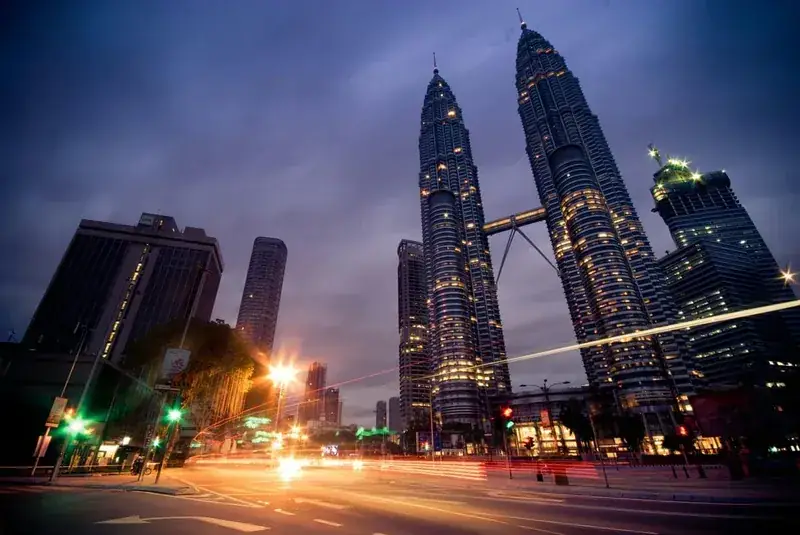
As the day cools, head to KLCC. The Petronas Towers, at 452 metres, remain the tallest twin towers in the world. The show starts around 7pm when the façades light up: the best photo is taken from KLCC Park, facing the fountains, or from the Saloma Link pedestrian bridge.
If you want to go up, book online in advance: the 86th-floor observation deck and the 41st-floor double bridge are often sold out at weekends. The Lake Symphony fountain light and music show is free and runs nightly at 8pm, 9pm and 10pm.
Day 2: Batu Caves, Little India and the viewpoints
Day two takes you out of the centre to one of the region's most impressive sites, then back up to the heights.
Dawn — Batu Caves
Leave around 7am for the Batu Caves, 13 km north of the city (30–40 minutes by Grab, or the KTM Komuter train to Batu Caves station). The 272 colourful steps up to the main cave are far easier in the cool morning air, and you beat both the crowds and the heat. At the entrance, the 43-metre statue of the god Murugan is the tallest in the country.
Watch out for the macaques: they are fast and will grab bags, glasses and bottles. Keep your belongings closed and never feed them. The visit takes two to three hours. Our dedicated Batu Caves page covers opening hours, access and what to know before you go.
Midday — Brickfields, the Indian quarter
On the way back, stop in Brickfields (Little India), near KL Sentral. Buddhist Maha Vihara temple, saris, spices, and above all outstanding South Indian food: crisp dosa, banana leaf rice served on a banana leaf, vegetarian thali. This is KL's best spot for an authentic Indian lunch under RM 20.
Afternoon — KL Tower and Forest Eco Park
Menara Kuala Lumpur (KL Tower), 421 metres, offers the most complete view of the city: the Petronas Towers in the distance, the hills to the north, and the jungle just below. The outdoor deck and skydeck are worth the RM 52 observation-deck ticket — considerably less than the full package.
Right behind it, KL Forest Eco Park is a delightful urban anomaly: 9 hectares of primary rainforest in the middle of the city, with a free canopy walk 200 metres from the tower. An hour of shaded walking without leaving town.
Evening — Jalan Alor
End the day on Jalan Alor, the former "sin street" turned into Kuala Lumpur's most famous street-food lane. Every evening dozens of stalls set up: satay skewers, ikan bakar (grilled fish), wonton mee, fresh fruit and sugarcane juice. Tourist prices but reasonable, and an atmosphere like nowhere else. It is one of the experiences not to miss, even for a single night in KL.
Day 3: parks, shopping and rooftops
The first two days are intense: day three is calmer, split between urban nature, shopping and night-time views.
Morning — KL Bird Park and the Lake Gardens
KL Bird Park is home to more than 3,000 birds in a huge open-air aviary, including a whole zone where flamingos and parrots roam free. Next door, the Perdana Lake Gardens combine the botanical garden, the orchid garden and the hibiscus garden — perfect for a slow morning.
Afternoon — Bukit Bintang and Pavilion
Bukit Bintang is the city's shopping and nightlife district. Pavilion Kuala Lumpur gathers hundreds of brands, from luxury to local labels, with an outdoor fountain show at 8pm. Ten minutes' walk away, Jalan Bukit Bintang and its run of malls (Lot 10, Sungei Wang, Fahrenheit 88) let you compare, browse and shelter from the heat or the tropical rain.
Mandatory break: a cendol or ais kacang at Lot 10 Hutong, the "food court of legends", which brings together historic stalls from all over the country.
Evening — a rooftop facing the towers
You cannot leave KL without a rooftop evening. The city has one of Asia's most dynamic rooftop scenes, with bars perched on the 30th, 50th or 60th floor looking straight at the Twin Towers. Our guide to the best rooftops in Kuala Lumpur lists the addresses, the dress code and the ideal time to go up. Book for Saturday night: the best terraces fill up fast.
Where to stay in Kuala Lumpur: which district to choose?
For a three-day trip, location matters more than the hotel's star rating: in KL, you easily lose time in transport.
| District | Best for | Price/night (3–4★ hotel) |
|---|---|---|
| KLCC | First visit, Petronas Towers view | RM 250–450 |
| Bukit Bintang | Shopping, nightlife, food | RM 180–350 |
| Chinatown | Budget travellers, local vibe | RM 90–180 |
| KL Sentral | Connections, day trips | RM 150–280 |
| Bangsar | Restaurants, residential feel | RM 220–400 |
Our full selection of hotels, by budget and district, is on the Kuala Lumpur hotels page. Book at least two weeks ahead in high season (June–August and December).
Budget for 3 days in Kuala Lumpur
| Item | Backpacker budget | Comfort budget |
|---|---|---|
| Accommodation (3 nights) | RM 270–450 | RM 750–1,350 |
| Meals (street food + 1 restaurant/day) | RM 90–150 | RM 300–500 |
| Transport (Grab + public transport) | RM 60–100 | RM 150–250 |
| Activities and tickets | RM 100–150 | RM 250–400 |
| Total per person | ~RM 520–850 (€110–180) | ~RM 1,450–2,500 (€300–530) |
Note: Kuala Lumpur remains one of the most affordable capitals in Southeast Asia for travellers. Entry to the main cultural sites (Batu Caves, temples, Masjid Jamek) is free or symbolic; most of the budget goes on accommodation and rooftops.
How to get around Kuala Lumpur
- Grab (the local Uber): the simplest, cheapest option for short trips. Expect RM 10–25 for a city-centre ride.
- MRT, LRT and monorail: a modern, cheap network (RM 1–6 per trip), ideal for linking KLCC, Bukit Bintang and KL Sentral. Buy a Touch 'n Go card.
- KTM Komuter: handy for Batu Caves and some day trips.
- KLIA Ekspres: airport → KL Sentral in 28 minutes, RM 55. Our Transport in Malaysia page covers all the options, including private airport transfers.
Avoid classic metered taxis between midnight and 6am (50% surcharge) and always use an app: prices are fixed and tracked.
When to go and how long to stay
The best time to visit Kuala Lumpur runs from May to July and December to February: shorter showers and temperatures around 30–33°C. The northeast monsoon (November–January) brings frequent but brief downpours; the southwest monsoon (May–September) is milder on the west coast.
Three days are enough for the heart of the city. If you can stay five, add a day trip: Malacca (2 hours by road), Genting Highlands or Putrajaya. To go further, see our full Kuala Lumpur destination guide and the tours and excursions departing from the capital.
📋 Useful resources
- Kuala Lumpur destination guide — districts, history, tips
- Activities & excursions — book in advance
- Kuala Lumpur hotels — selection by district and budget
- KL rooftops — bars with a view of the Twin Towers
- Transport in Malaysia — airport, Grab, trains
- Batu Caves — opening hours and access
FAQ: Kuala Lumpur in 3 days
Is 3 days enough for Kuala Lumpur?
Yes for the highlights: Chinatown, Merdeka Square, the Petronas Towers, Batu Caves, Bukit Bintang and a rooftop. Three days cover the city centre plus one nearby excursion. To add Malacca, Penang or the Cameron Highlands, plan five to seven days instead.
Which is the best district to stay in KL for a first visit?
KLCC for the views and calm, Bukit Bintang for nightlife and shopping, Chinatown for budget travel. All three are well served by the monorail and MRT, and 10–20 minutes apart by Grab.
What budget should I plan for 3 days in Kuala Lumpur?
Roughly RM 520–850 (€110–180) per person on a backpacker budget, and RM 1,450–2,500 (€300–530) for comfort, including 3–4 star accommodation. Street food and public transport are very affordable.
Should I book the Petronas Towers in advance?
Yes, strongly recommended, especially at weekends and in high season. Sunset slots (6–7pm) sell out days ahead. Book online on the official website.
Can I visit Batu Caves without a car?
Yes. The KTM Komuter train links KL Sentral to Batu Caves station in about 30 minutes for under RM 3. A Grab costs RM 25–40 from the city centre. Leave before 8am to avoid the heat and the crowds.
👉 Planning your first trip to Kuala Lumpur and want a tailor-made itinerary, airport transfers or pre-booked excursions? Get in touch — we'll help you build a stress-free three-day plan.
Ready to explore Malaysia?
Book your transfer, plan your trips and find the right contacts.
You may also like
MM2H 2026: Requirements, Tiers and Costs of Malaysia's Long-Stay Visa
MM2H 2026 explained: the four categories (Silver, Gold, Platinum, SEZ/SFZ), fixed deposits, compulsory property purchase, minimum stay, real fees, tax treatment, health insurance and the full application process.
Buying a Car in Malaysia: The Complete Guide for Expats (2026)
Can a foreigner buy a car in Malaysia? 2026 new and used prices, licence, Puspakom inspection, insurance, road tax, unsubsidised fuel and financing: the complete guide to buying, registering and driving without surprises.
Opening a Bank Account in Malaysia: The Complete Guide for Expats (2026)
Passport, visa, proof of address, minimum deposit: how to open a bank account in Malaysia in 2026, which banks to choose, what it costs, and the alternatives if you do not yet hold a long-stay visa.